

 By Pete Pennicott | October 10, 2026
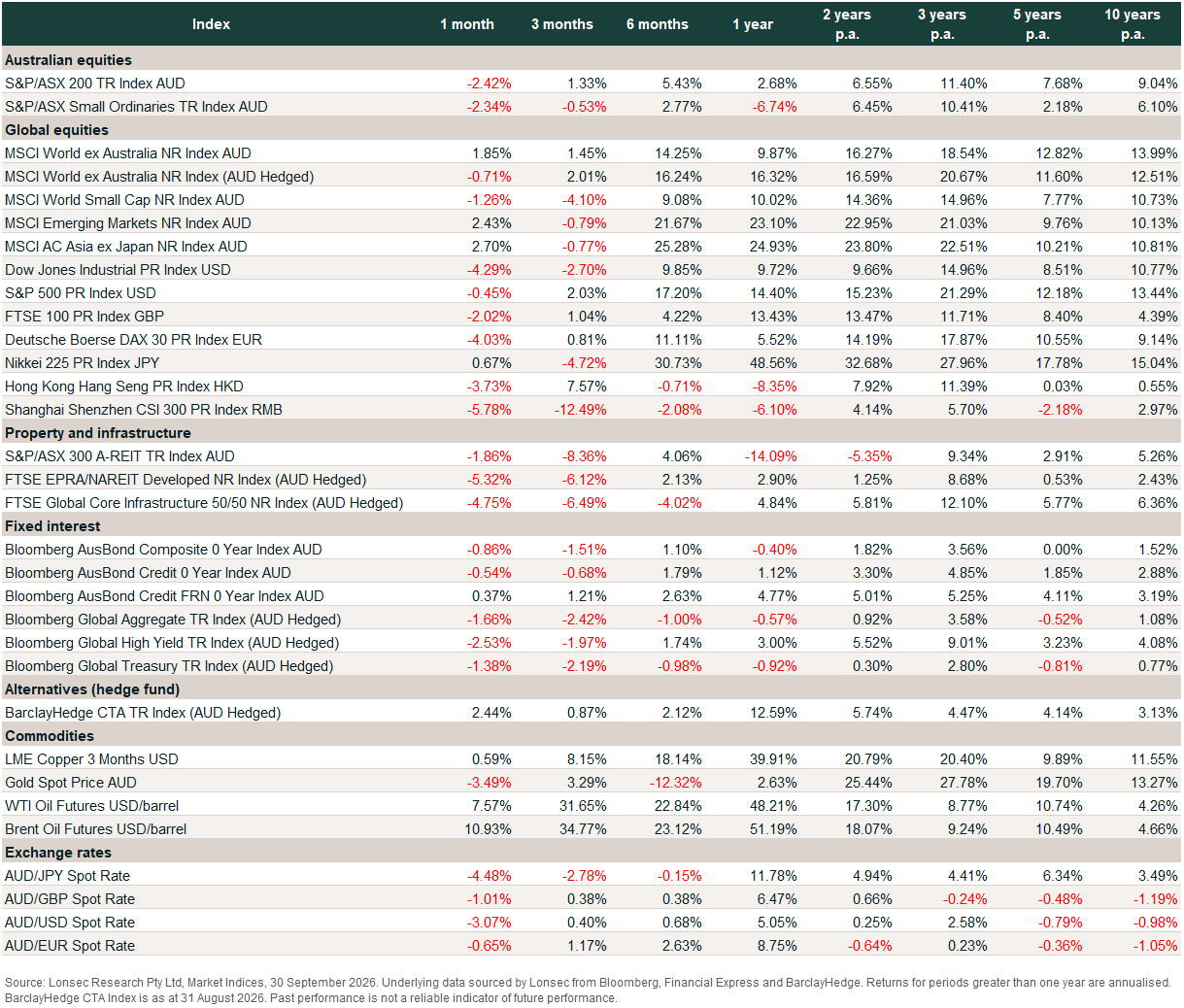
If August was all about company earnings, then September was all about interest rates. Four major central banks raised rates in the same month, and as a result bond yields climbed to multi-year highs around the world. Almost every market move traced back to that one force.
Australian equities
The ASX 200 Accumulation Index returned −2.42% in September. It peaked early in the month, then slid to a three-month low around 23 September. A late rebound lifted it off the lows, but the market is now broadly flat for the calendar year.
This time the pain was spread across the board. The ASX 20 fell 1.68%, the MidCap 50 fell 3.37% and the Small Ordinaries fell 2.34%. After August’s big gap between large and small companies, size made little difference.
September sits outside reporting season. So the month was driven by rates, bond yields, oil and the currency rather than company news. Sector returns tell the story.
Technology was hit hardest. Higher rates hurt growth stocks more than most. Governor Bullock also flagged spending on AI data centres as a source of inflation, which didn’t help sentiment.
The final day of the month brought some relief. August inflation came in slightly below forecast, and rate-sensitive sectors like property bounced sharply.
Looking ahead, there are reasons to be cautious on Australian shares. Consensus FY27 earnings growth has been cut by around 3.6% since 30 June, to roughly 6.7%. Yet the ASX 200 still trades on about 18 times forward earnings, against a long-run average of around 16 times. My take? Earnings now need to do the heavy lifting, at a time when households are under real pressure.
Global equities
Global markets were mixed in local currency terms. In the US, the S&P 500 slipped 0.45% and the Dow fell 4.29%. The technology-heavy Nasdaq rose, carried by a small group of AI-related companies. Eight of eleven US sectors fell, with financials down more than 7% as bond yields jumped.
Elsewhere, the Nikkei 225 rose 0.67% even as the Bank of Japan raised rates. The FTSE 100 fell 2.02%, the DAX 4.03% and the Hang Seng 3.73%. China’s CSI 300 fell 5.78% on weak domestic data and rising US-China tech tensions.
Emerging markets were more resilient, returning 2.43% in Australian dollars. Taiwan was the standout, rising almost 4% to record highs on demand for semiconductors and AI hardware.
For Australian investors, the currency again made all the difference. The MSCI World ex Australia index returned −0.71% hedged but 1.85% unhedged. In August a rising dollar cost unhedged investors. In September a falling dollar rescued them.
Property and infrastructure
Rising bond yields hit real assets again. The ASX 200 A-REIT index returned −1.76%, after a sharp bounce on the last day of the month. Global listed property did much worse, with the FTSE EPRA/NAREIT Developed index down 5.32% hedged.
Global listed infrastructure fell too. The S&P Global Infrastructure index returned −4.23% and the FTSE Global Core Infrastructure 50/50 −4.75%, both hedged. Both sectors have long-dated, yield-sensitive earnings. When bond yields rise this quickly, they tend to struggle.
Fixed interest
It was a tough month for bonds everywhere. Yields rose sharply, which means bond prices fell.
US Treasuries led the sell-off. The 2-year yield rose 55 basis points to 4.89% and the 10-year rose 53 basis points to 5.28%. The 30-year rose above 5.6%, its highest level since 2002. Drivers included the Fed’s hike, stubborn inflation, higher oil prices and heavy government borrowing. Big tech companies borrowing to fund AI infrastructure added to the supply.
The same pattern played out around the world. Japan’s 10-year yield rose above 3% for the first time since 1996. UK 30-year gilt yields hit their highest level since 1998. In France, the 10-year yield rose above 4.5% for the first time since 2008 amid budget worries.
Australian yields followed. The 3-year yield rose 27 basis points to 4.93%. The 10-year rose 26 basis points to 5.35%, its highest level since 2011, after peaking near 5.40% mid-month. The 30-year rose 19 basis points to 5.78%, close to record highs.
The Bloomberg AusBond Composite returned −0.86%, with government bonds weaker at −0.95% and inflation-linked bonds −0.64%. Floating rate credit returned 0.37% and cash (the Bank Bill index) 0.36%.
Global fixed interest fared worse. The Bloomberg Global Aggregate returned −1.66% hedged. Credit gave no shelter this time, with global high yield down 2.53% and emerging market debt down 3.63%. US high yield spreads widened 45 basis points to 3.18%.
There is a silver lining. Higher starting yields improve the outlook for future bond returns. Overwhelmingly our research now shows that Australian government bonds offer an attractive yield and some downside protection if growth weakens.
Currencies and commodities
The Australian dollar fell 3.07% against the US dollar and finished below 70 US cents. It also fell 4.48% against the yen, 1.01% against sterling and 0.65% against the euro. It rose 1.79% against the New Zealand dollar.
The US dollar index rose around 2%, helped by the Fed’s hike and higher US yields. Weaker iron ore prices added to the pressure on our dollar.
Oil was the big mover. Attacks on tankers around the Strait of Hormuz pushed Brent crude above US$100 a barrel in mid-September. Brent futures finished the month up 10.93% and WTI up 7.57%. By month-end, naval escorts and alternative shipping routes had restored most Gulf crude flows.
Gold reversed sharply. It fell 3.49% in Australian dollar terms and more in US dollars. Higher real yields and a stronger US dollar reduced the appeal of an asset that pays no income.
Iron ore fell back below US$100 a tonne on weak Chinese steel demand. Among the broader indices, the CRB Index was flat at −0.08% and the S&P Goldman Sachs Commodity Index rose 1.91%. Copper added 0.59% and aluminium fell 0.96%.
Australia
The RBA raised the cash rate 0.25% to 4.60% on 29 September. It was the fourth increase this year, adding a full 1% since January. The Board said spending and investment had been stronger than expected and productivity growth remained weak. It also said upside risks to inflation had begun to materialise. And it noted the impact of earlier rate rises is still flowing through the economy.
The written statement was hawkish. Governor Bullock struck a more cautious tone at the press conference.
The August CPI landed the next day. Headline inflation jumped to 4.0% from 3.5%, just below the 4.1% forecast. The trimmed mean held at 3.6%. Housing remained the largest driver at 5.7% over the year, and higher oil prices lifted transport costs.
Markets now expect at least two more rate hikes over the next 12 months. That isn’t a certainty. One research house we follow thinks current pricing could prove too aggressive. In its view, a cut would need a clear trigger, such as a deeper housing downturn or unemployment rising above 5%.
The economy is starting to show the strain. Unemployment edged up to 4.6%, its highest level since late 2021. GDP grew 0.4% in the June quarter and 2.1% over the year. But the six-month annualised pace has slowed to just 1.4%.
The core problem is productivity. When productivity barely grows, even slow economic growth can keep inflation too high. That’s why the RBA keeps hiking while growth is soft.
Residential property is now in a clear downturn. National home values fell around 1% in September, a sixth consecutive monthly decline. Building approvals continued their negative trend. Westpac consumer confidence sits around 84, extremely low by historical standards, and NAB business confidence was −8.4.
United States
The Federal Reserve raised rates 0.25% to a range of 3.75–4.00% at its 15–16 September meeting. It was the first hike since 2023 and the vote was unanimous. The Fed cited stubborn inflation and energy shocks linked to the Middle East.
The Fed’s updated forecasts point to one more 0.25% hike by the end of 2026. It also revised 2026 growth up to 2.3% and nudged its inflation forecasts higher.
The data gave it room to act. Headline CPI held at 3.4% in August, while core CPI eased to 2.4%. Second quarter GDP was revised up to 2.2% annualised, from 1.5%. Retail sales rose 1.2% in August, a sharp rebound.
The ISM Manufacturing PMI eased to 54.5 in September, a ninth straight month of expansion. But the prices-paid index surged to 77.9, its highest since the Iran conflict began. That points to renewed cost pressure in the pipeline.
Rest of world
The ECB raised rates 0.25% to 2.5%. Eurozone headline inflation rose to 3.8% in September, up from 3.3% in August, as oil prices surged. Core inflation picked up to 2.5%. Growth remains sluggish, at 0.4% for the June quarter and around 1% over the year.
The Bank of England held rates steady, though three of its nine members voted for a hike. In France, a new government under Prime Minister Sebastien Lecornu announced large spending cuts amid protests.
The Bank of Japan raised its policy rate 0.25% to 1.25%, its highest level since 1995. It was a split decision, just three months after the previous hike in June. Headline inflation held at 1.9% in August.
China’s official manufacturing PMI returned to expansion at 50.1 in September, after two months of contraction. Consumer inflation picked up to 0.8% in August, but food prices kept falling. Exports remained strong, up 25% over the year, while domestic demand stayed weak.
On trade, Presidents Trump and Xi met on 24 September. They agreed to lower tariffs on around US$30 billion of goods each way and extend the trade truce by around two months. The harder issues of rare earths, technology and security remain unresolved.
Pete is the Co-Founder, Principal Adviser and oversees the investment committee for Pekada. He has over 18 years of experience as a financial planner. Based in Melbourne, Pete is on a mission to help everyday Australians achieve financial independence and the lifestyle they dream of. Pete has been featured in Australian Financial Review, Money Magazine, Super Guide, Domain, American Express and Nest Egg. His qualifications include a Masters of Commerce (Financial Planning), SMSF Association SMSF Specialist Advisor™ (SSA) and Certified Investment Management Analyst® (CIMA®).