

 By Pete Pennicott | August 11, 2026
Global equities
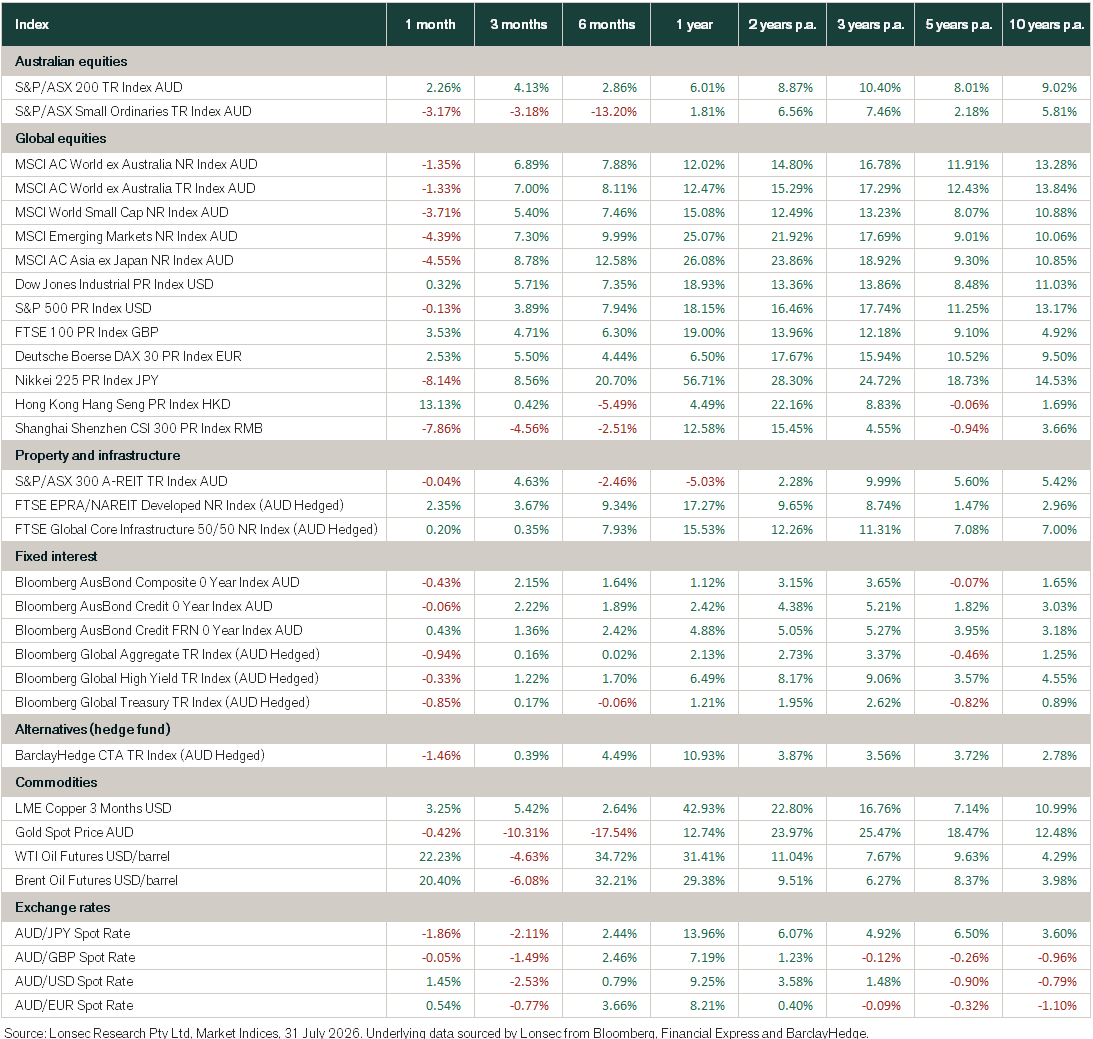
Global equities were softer in aggregate. Australia and pockets of value-oriented developed markets performed well, while the previously dominant AI trade suffered its most significant setback since the buildout began. The MSCI AC World ex Australia fell 1.35% in AUD terms as the US and Asian tech-heavy markets came under pressure.
Markets were sharply reassessing whether future returns will justify the enormous AI-related capital expenditure by US hyperscalers. The catalysts included the emergence of cheaper open-weight models (including China’s Kimi K3), Alphabet’s free cash flow turning negative for the first time as capex guidance was raised again, and broader questions about token costs and monetisation. Importantly, the fundamentals haven’t deteriorated to the same degree as sentiment. US Q2 earnings growth is tracking around 45% year-on-year, well above the 22% expected at the start of the season.
Emerging markets fell 4.39% in AUD terms, with the sell-off concentrated in the semiconductor and AI supply-chain names in Korea and Taiwan. Nikkei 225 (in yen terms) fell 8.14%. On the other side of the ledger, Hong Kong’s Hang Seng rallied 13.13% as investors rotated into the market. The equal-weight S&P 500 outperformed the cap-weighted index globally, reflecting the broader rotation away from the mega-cap AI names into financials, energy, real estate and staples.
Australian equities
The ASX 200 rose 2.26% for the month, its fourth consecutive monthly gain and one of the stronger developed-market outcomes globally. Sector leadership was concentrated: Energy jumped 12.06% on higher oil prices, and Financials added 5.79% on the back of the RBA hold and firm bank earnings expectations. Consumer Discretionary added 1.11%. At the other end, Information Technology fell 4.78% being caught in the global reassessment of AI-linked valuations. Small caps lagged materially, with the S&P/ASX Small Ordinaries falling 3.17% and the market’s largest names leading the charge instead.
Listed property was mixed – the S&P/ASX 300 A-REIT sector edged down 0.04% but the FTSE EPRA NAREIT Developed (hedged) index gained 2.35%. Australian listed infrastructure was broadly flat.
Fixed interest, currencies & commodities
Bond markets had a difficult month, with the tension between central banks and investors the defining feature. In the US, the FOMC voted 9-3 to hold the policy rate at 3.50-3.75%, with three regional presidents (Hammack, Kashkari, Logan) pushing for a hike. Bond investors read the split as evidence the Fed isn’t serious enough about anchoring inflation expectations, and responded by selling Treasuries. The US 30-year yield hit 5.24%, its highest level since 2007. Domestic bonds also weakened, with the Bloomberg AusBond Composite Index down 0.43% for the month, and the global aggregate index off 0.94%.
Commodities and currencies reflected the same themes. WTI crude jumped 22.23% for the month as the fragile Middle East ceasefire broke down and shipping through the Strait of Hormuz was disrupted again. Brent oil briefly touched USD 100/bbl before falling back to USD 88 by month-end. Gold in AUD terms fell 0.42%, which was unusual given the volatile geopolitical backdrop. Investors chose Treasury yields over non-yielding metals. The Australian dollar strengthened 1.45% against the US dollar, benefiting from firmer commodity prices and reflecting a broader reversal in USD momentum after the FOMC meeting raised questions about the Fed’s credibility.
Australia
The domestic economic picture continues to shift, and on balance looks better than most of Australia’s peers. After three consecutive 0.25% RBA hikes earlier this year, July delivered several data points suggesting the tightening cycle is beginning to bite. The June quarter CPI came in below expectations, with headline inflation easing to 3.8% year-on-year and core (trimmed mean) inflation steady at 3.6%. Markets pared back expectations of further RBA tightening to around 14 basis points of additional hikes by year-end.
The labour market continues to defy expectations. Total employment reached a record 14.82 million people in June, and the unemployment rate held at 4.4%. Wage growth has moderated in line with easing inflation, but the strength of the jobs market has kept household incomes underpinned. This resilience helps explain why Australian shares have held up better than global peers even as monetary policy has tightened.
United States
US economic data remains resilient. The labour market continues to hold up, corporate earnings remain strong outside the AI-related pressure noted above, and consumer spending has been steady. Fiscal stimulus from the ‘One Big Beautiful Bill’ continues to flow through. However, inflation is proving stickier than the Federal Reserve would like, and the late-month oil price spike is likely to feed through to headline inflation in the coming months.
The July FOMC meeting was the most contested of Kevin Warsh’s tenure so far. The Committee voted 9-3 to hold rates at 3.50-3.75%, with three regional Fed presidents pushing for a hike. The last time three FOMC members dissented was September 2016 and Warsh described the deliberations as a “good family fight” in his post-meeting press conference.
Rest of the world
The IMF used its 8 July World Economic Outlook Update to cut its global outlook, driven largely by the ongoing Middle East conflict and its flow-through to energy prices. Global inflation is now forecast at 4.7% for 2026 (up from 4.4% in April). Australia’s 2026 GDP growth forecast was trimmed to 1.9% from 2.0%, which notably was one of the more modest revisions applied, reflecting the relative resilience of the domestic backdrop.
In China, growth momentum slowed as real gross domestic product (GDP) was up 4.3% year on year in 2Q26, missing expectations and down from 5% in 1Q26. This GDP reading is likely to increase expectations for targeted policy support at the July Politburo meeting.
Elsewhere, the Bank of Japan held rates at 1% on an 8-1 vote but signalled ongoing normalisation. The European Central Bank kept the deposit rate at 2.25% following June’s hike, but Lagarde’s press conference leaned hawkish.
Geopolitics remains a central variable. The renewed Middle East escalation and new US global tariff announcements are both reminders that the current environment is unusually policy-driven, and market moves can shift quickly on headlines rather than fundamentals.
Thanks for reading. If you want to discuss any of the above information or your personal investment strategy, then book a chat with your financial adviser here.
Pete is the Co-Founder, Principal Adviser and oversees the investment committee for Pekada. He has over 18 years of experience as a financial planner. Based in Melbourne, Pete is on a mission to help everyday Australians achieve financial independence and the lifestyle they dream of. Pete has been featured in Australian Financial Review, Money Magazine, Super Guide, Domain, American Express and Nest Egg. His qualifications include a Masters of Commerce (Financial Planning), SMSF Association SMSF Specialist Advisor™ (SSA) and Certified Investment Management Analyst® (CIMA®).