

 By Pete Pennicott | May 16, 2026
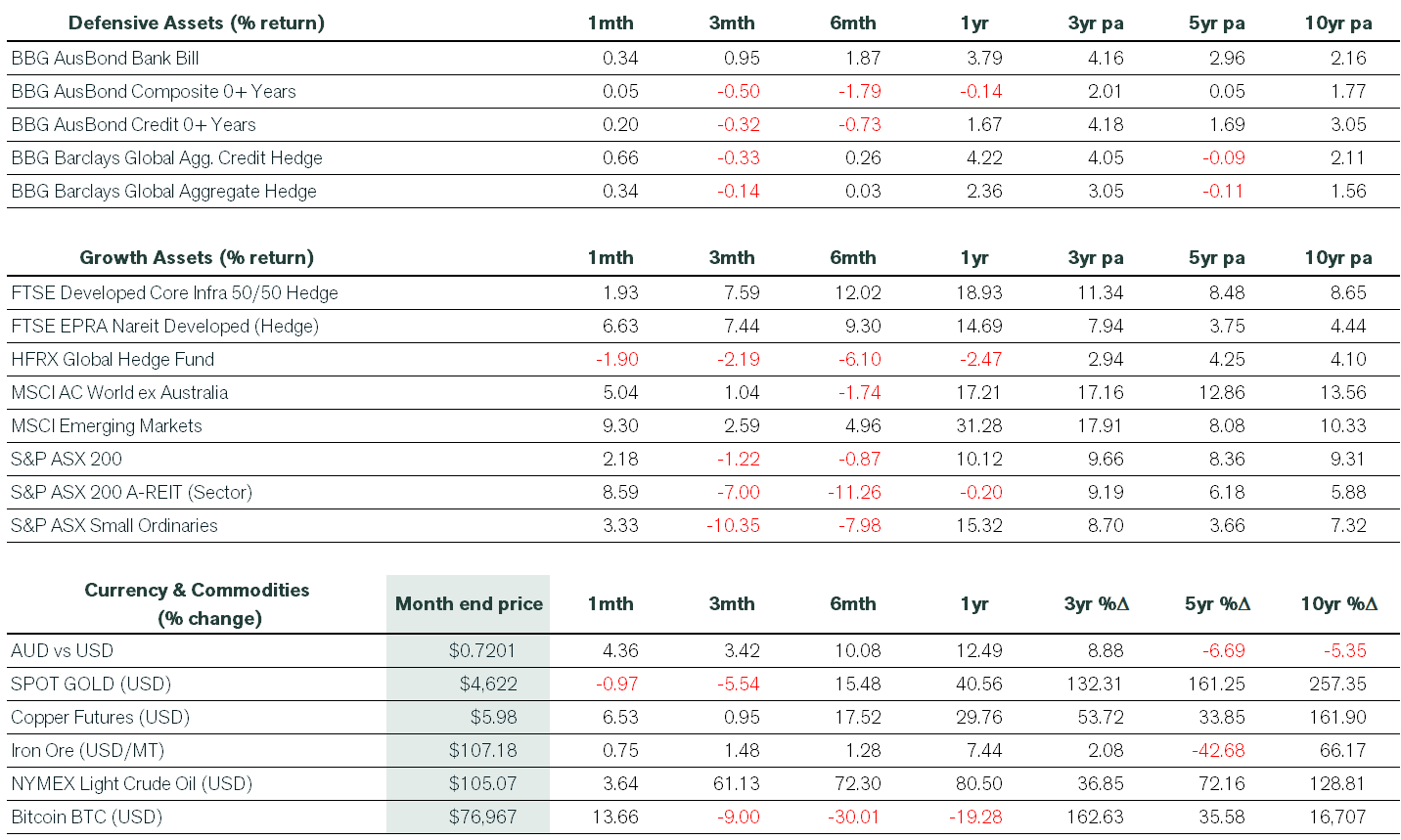
Strong financial market performance in April was underpinned by the announcement of a ceasefire in the Iran War at the beginning of the month. This raised hopes that an eventual reopening of the Strait of Hormuz would allow the passage of crude and other critical commodities to resume. Oil prices slumped below US$100 a barrel initially, and investors rejoiced. However, after high-level peace talks reached a stalemate, Iran said it would require ships to pay a toll to transit through the strait. Trump described the move as “world extortion” and ordered a naval blockade of the strait in a bid to damage Iran’s economy and curb its nuclear program.
Despite the ratcheting up of tensions, the ceasefire largely held throughout the month. On the final trading day, Brent crude briefly reached a fresh wartime high above US$126 a barrel after Axios reported that Trump is weighing new military options. The Australian dollar finished the month at 72c versus the greenback, up 4.4%.
Global equities
A rebound in sentiment across risk assets was reflected in a 9.5% jump in the MSCI ACWI ex-Australian index when measured in local currency terms. However, the strong appreciation of the Australian dollar throughout the month dampened returns for unhedged domestic investors (+5.0%). The rebound was yet more pronounced in emerging market equities, which witnessed a 13.3% return spike in local currency and 9.5% in Australian dollar terms. The gains were largely concentrated in Taiwan and South Korea, as AI semiconductor trades were re-implemented.
Including dividends and in US dollar terms, the benchmark S&P 500 index rebounded 10.5%, the tech-heavy Nasdaq 100 spiked 15.7% (its best month in twenty-three years), while returns for the Dow Jones Industrial index increased 7.2%. The Magnificent Seven jumped 14.9%, as strong corporate earnings continued to exceed expectations. Growth easily outpaced value indices in April, with a strong US earnings season highlighted by most companies beating consensus expectations, and the hyperscalers leading the pack. S&P 500 GICS returns were dominated by double-digit increases in Communications, Technology and Consumer Discretionary.
Australian equities
Back home, the ASX 200 gained a more moderate 2.2%, underperforming domestic small caps, which returned 3.3%. On the domestic front, ASX 200 GICS sector performance for April was led by Technology (+13.7%). At the opposite end of the spectrum, Health Care (-8.4%) failed to participate in the rally, as Cochlear and CSL found new ways to disappoint. A-REITs staged a strong relief rally, up 8.6%, led by sector behemoth Goodman Group. Global property returned 6.6%, with a more muted 1.9% increase in global listed infrastructure.
Fixed interest, currencies & crypto
Fixed interest markets benefited from lower average oil prices, but domestic bonds underperformed as concerns about inflation continued to mount. The Australian composite bond index was barely positive, with returns constrained by government treasuries. Cash outperformed domestic credit, which now sees relative returns between these asset classes broadly in line over the past three years. Global credit was significantly stronger on tighter spreads due to a resumption of risk-on sentiment. Global bond returns, however, were moderated via negative performances by Japan and the UK. Japanese government bond (JGB) returns were especially weak – the Bank of Japan’s more hawkish tone and upward revisions to its inflation forecasts disappointed investors and saw 10-year JGB yields rise to their highest level since 1997.
Meanwhile, oil prices were volatile – in a month where Brent crude reached a new crisis high of US$126.41, the United Arab Emirates announced its withdrawal from OPEC.
The US dollar index (DXY) fell 1.9%, resuming its downtrend seen since the beginning of the Trump presidency.
Finally, Bitcoin jumped 13.7% in April (its best move in twelve months) as investor appetite for risk increased.
Australia
On the economic front, Australia’s headline CPI inflation picked up to 1.1% m/m in March from a steady reading in February. Annual inflation from the monthly series printed at 4.6%, up from 3.7%. Underlying trimmed mean inflation – the RBA’s preferred measure – rose to 0.3% m/m, but held at 3.3% y/y. On a quarterly basis, underlying inflation came in at 0.8% q/q and 3.5% y/y. The Australian Bureau of Statistics said that transport inflation climbed 8.9% y/y, driven by soaring petrol prices.
Meanwhile, the unemployment rate in March held steady at 4.3%. Trend employment growth was just above 30,000 for the month, with no change in the participation rate.
United States
In the US, the advanced estimate for Q1 GDP showed that the economy expanded 0.5% q/q and 2.3% y/y, above expectations. The anticipated rebound in government consumption spending (post the shutdown in Q4) was joined by solid household spending and the ongoing AI infrastructure investment boom. This culminated in domestic final demand rising by a solid 0.7% in the quarter, while net exports were negative. Meanwhile, nonfarm payrolls rose 178,000 in March, the most since late 2024, after revisions showed a sharper decline in February.
US inflation surged in March by the most in nearly four years as the war with Iran sent fuel prices skyrocketing. The CPI rose 0.9% m/m and 3.3% y/y, with a record increase in gas prices responsible for nearly three-quarters of the monthly increase. Turning to monetary policy, an increasingly divided Federal Reserve kept interest rates unchanged in April, but several officials opposed messaging that further rate cuts could be ahead. Amid expectations for a routine vote to hold the benchmark funds rate steady, the committee instead was split along 8-4 lines. The last time four FOMC members dissented was in October 1992.
Rest of the world
Finally, the Bank of Japan kept its short-term policy rate unchanged at 0.75% at its April 2026 meeting, the highest level since September 1995. The widely expected decision passed by a 6–3 vote, amid surging energy prices, with the three dissents calling for a 25bp increase to the policy rate. In its quarterly outlook, the BoJ raised its FY26 core inflation outlook to 2.8% from 1.9%, while trimming the FY26 growth forecast to 0.5% from 1.0%, reflecting softer domestic momentum.
Thanks for reading. If you want to discuss any of the above information or your personal investment strategy, then book a chat with your financial adviser here.
Pete is the Co-Founder, Principal Adviser and oversees the investment committee for Pekada. He has over 18 years of experience as a financial planner. Based in Melbourne, Pete is on a mission to help everyday Australians achieve financial independence and the lifestyle they dream of. Pete has been featured in Australian Financial Review, Money Magazine, Super Guide, Domain, American Express and Nest Egg. His qualifications include a Masters of Commerce (Financial Planning), SMSF Association SMSF Specialist Advisor™ (SSA) and Certified Investment Management Analyst® (CIMA®).