

 By Pete Pennicott | November 11, 2026
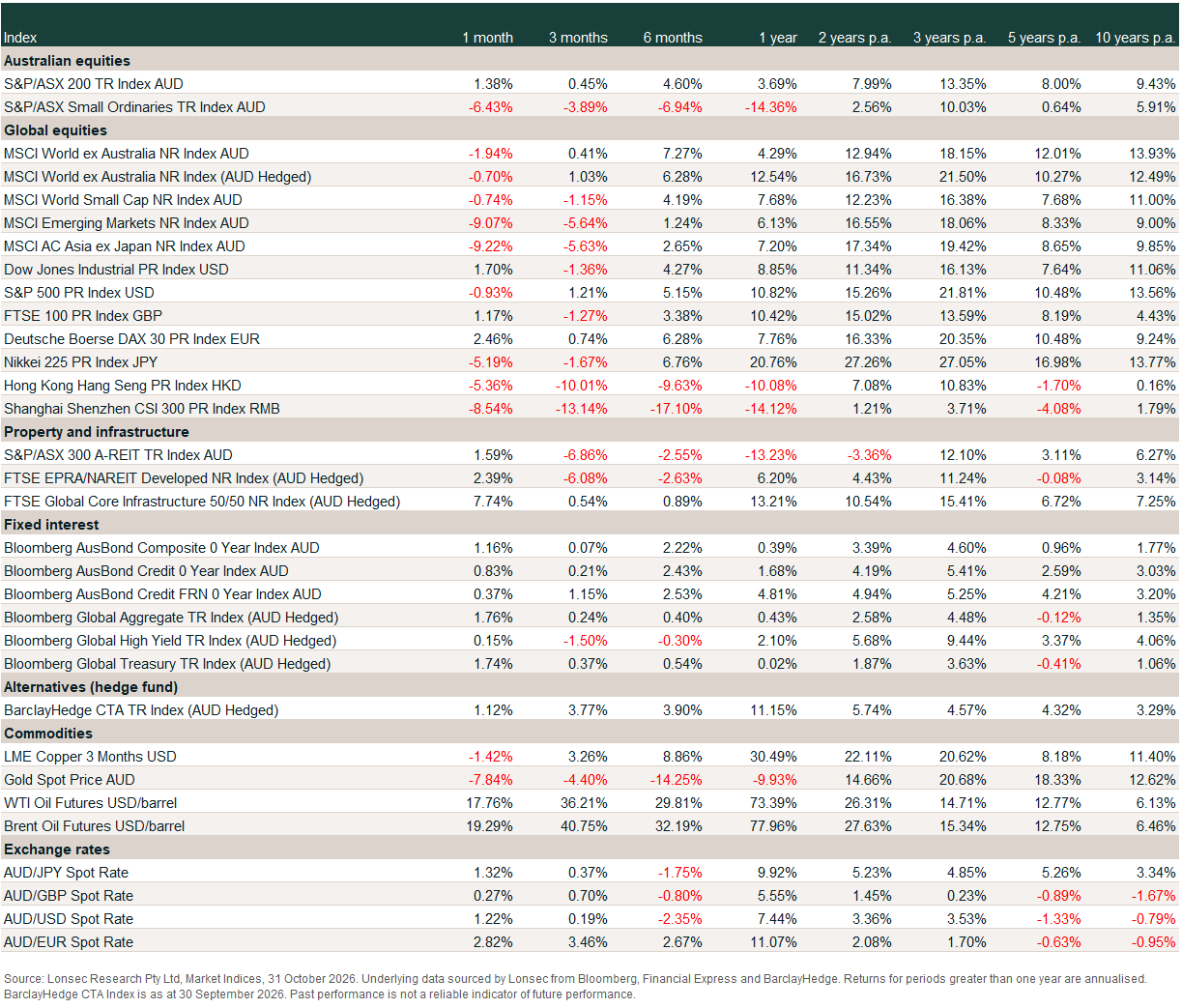
October was a reminder of why diversification matters. AI-related shares fell sharply around the world. But Australian shares, listed property, infrastructure and high-quality government bonds all delivered positive returns. Those gains helped offset weakness in global and emerging market shares.
Australian equities
The S&P/ASX 200 TR Index returned 1.38% in October, despite choppy trading. With relatively little exposure to AI, the local market held up better than most. Investors favoured defensive and income-paying sectors and moved away from resources.
Larger companies did best. The ASX 20 rose 2.65% and the MidCap 50 rose 0.87%. The Small Ordinaries fell 6.43%, as weakness in resources and more speculative growth companies weighed on the smaller end of the market.
Selected ASX 300 sector and industry-group total returns show a clear rotation.
Global equities
Global markets were mixed. The country-index figures below are price returns, excluding dividends. In the US, the S&P 500 fell 0.93% for its second monthly decline, while the Dow rose 1.70%. The Nasdaq fell 5.3%, its worst month since March 2025.
The main story was doubt over AI spending. US third-quarter earnings were generally healthy. Of the S&P 500 companies that had reported, around 80% beat expectations. But a few large technology misses, and heavy spending plans by the biggest AI companies, weighed on sentiment. Companies that rent out AI computing power came under particular pressure.
The rest of the market fared much better. The equal-weight S&P 500, which gives each company the same weighting, rose 5.0%. That was its biggest outperformance over the standard index since April 2009. Energy and defensive sectors, including consumer staples, health care and utilities, gained. Communication services and technology were the weakest sectors.
In Europe, the FTSE 100 rose 1.17% and the DAX 2.46%. Asia was the weakest region. The Nikkei 225 fell 5.19%, the Hang Seng 5.36% and China’s CSI 300 8.54%. Technology-heavy markets such as Taiwan and South Korea also fell.
Emerging markets returned −9.07% in Australian dollars. Brazil showed how quickly politics can move markets. Its share market rallied early in the month, then ended down 9.9% after President Lula won the runoff election.
For Australian investors, the currency worked against unhedged holdings this time. The MSCI World ex Australia index returned −1.94% unhedged but −0.70% hedged back into Australian dollars.
Property and infrastructure
Real assets bounced back as bond yields fell and investors sought more defensive income. The S&P/ASX 300 A-REIT TR Index returned 1.59%. The FTSE EPRA/NAREIT Developed Net Return Index rose 2.39%, hedged to Australian dollars.
Global listed infrastructure was a standout. The S&P Global Infrastructure Total Return Index returned 7.06% and the FTSE Global Core Infrastructure 50/50 Net Return Index 7.74%, both hedged to Australian dollars. Both sectors have long-dated, yield-sensitive earnings, so they tend to benefit when yields fall.
Fixed interest
High-quality government bonds played their traditional defensive role. Yields fell, which lifted the prices of existing fixed-rate bonds.
In the US, the 10-year yield reached 5.35% during October, a level last seen in 2002. It then fell back to around 4.9% by month-end, its largest monthly fall since late 2023. The 2-year yield fell to around 4.6% and the 30-year to around 5.3%. Softer jobs data helped, although markets still expect further rate rises.
France was the exception. Social unrest and persistent budget deficits pushed its 10-year yield above 5% on 21 October, a 24-year high. The gap over German yields widened to around 170 basis points, the widest since the eurozone debt crisis.
Australian yields followed a similar path. The 10-year yield climbed to around 5.42% during October, its highest level since 2011, before easing to 5.11% by month-end. The AusBond Composite returned 1.16%, with government bonds up 1.25% and inflation-linked bonds 1.74%. Corporate credit returned 0.83%, floating rate credit 0.37% and cash (the Bank Bill index) 0.37%.
Globally, the Bloomberg Global Aggregate returned 1.76% hedged and global treasuries 1.74%. Credit lagged government bonds. Global high yield returned just 0.15%, as investors questioned whether debt-funded AI spending would pay off in time. Credit spreads widened, especially for lower-rated borrowers. US high yield spreads widened around 29 basis points to 3.40%, and investment grade spreads around 10 basis points to 0.90%.
Currencies and commodities
The Australian dollar rose 1.22% against the US dollar. It also rose 2.82% against the euro, 1.32% against the yen, 1.27% against the New Zealand dollar and 0.27% against sterling. The US dollar index rose around 0.4%.
Oil was again the big mover. Tanker attacks, strikes on Saudi Arabia and fears of wider conflict with Iran pushed Brent crude to around US$118 a barrel by 30 October, up from around US$99 a month earlier. Brent futures finished the month up 19.29% and WTI up 17.76%.
Gold fell 7.84% in Australian dollar terms. In US dollars it was around US$3,900 an ounce on 30 October, down about 7% over the month. High US yields and expectations of further Fed rate rises reduced its appeal.
Metals were weaker. The benchmark Singapore iron ore contract fell 2.6%, after a 6.1% fall in September, as Chinese steel demand softened. Three-month LME copper prices fell 1.42% and aluminium 4.05%, both in US dollars.
Australia
The cash rate remained at 4.60% throughout October, between RBA meetings. But the inflation data kept pressure on for another rise. On 3 November, after month-end, the RBA raised the cash rate 25 basis points to 4.85%, its highest level since November 2008. It was a split decision, with six members voting for the increase and three voting to hold. The Board said inflation was broadly based and now expects it to stay above 3% for the coming year. It doesn’t expect inflation to reach the top of the 2–3% target band until late 2027.
The September monthly CPI showed headline inflation rising to 4.3% from 4.0% in August. Prices rose 0.8% in September alone. The trimmed mean rose to 3.6% from a revised 3.5%, still above the RBA’s 2–3% target band. Higher fuel prices feed straight into headline inflation, so the oil price remains a key risk.
The labour market softened. Unemployment rose to 4.7% and employment fell by 39,000 in September.
That leaves households squeezed from several sides. Higher fuel prices, higher interest rates, falling home prices and less job security are all weighing on consumers.
United States
The Federal Reserve held rates at 3.75–4.00% at its October meeting, pausing after September’s increase. The vote was 10–2, with both dissenters favouring another hike.
The Fed’s statement described inflation as still elevated. Chair Kevin Warsh gave no explicit guidance on December, saying decisions would depend on incoming data. By month-end, markets were pricing more than an 80% chance of a December hike.
The data showed a strong economy with rising prices. US GDP grew at a 3.4% annualised rate in the September quarter, up from 2.2% in the June quarter. Inflation picked up to 3.7% in September from 3.4% in August, with higher petrol prices doing much of the work.
Rest of world
The ECB held its deposit rate at 2.50% in a unanimous decision. President Lagarde said a rate rise had been discussed. Markets are pricing more than an 80% chance of a December increase. Lagarde’s planned departure in February 2027 has put leadership succession in focus. Eurozone inflation rose to 3.8% in September, its highest level in three years, driven largely by energy costs.
In France, social unrest highlighted the country’s fiscal problems. Passing a credible 2027 budget is now the immediate test.
The Bank of Japan held its policy rate at 1.25%, with one member voting for a hike. It said underlying inflation had reached its 2% target and lifted its inflation forecast. Governor Ueda said decisions would be made meeting by meeting.
China’s economy grew 4.5% over the year to the September quarter, up from 4.3% in the June quarter. Exports remained strong, rising 36.3% over the year in September in US-dollar terms. But retail sales grew just 1.1%, and fixed-asset investment fell 7.2% over the first nine months. Consumer inflation was 0.9% and producer prices rose 5.0%.
Market data: Lonsec Market Indices, 31 October 2026. Australian equity returns include dividends. Country-index figures are local-currency price returns. Global equity and listed-property net-return indices include dividends after assumed withholding taxes. Hedged returns are hedged to AUD. Commodity returns are in USD unless stated otherwise.
Pete is the Co-Founder, Principal Adviser and oversees the investment committee for Pekada. He has over 18 years of experience as a financial planner. Based in Melbourne, Pete is on a mission to help everyday Australians achieve financial independence and the lifestyle they dream of. Pete has been featured in Australian Financial Review, Money Magazine, Super Guide, Domain, American Express and Nest Egg. His qualifications include a Masters of Commerce (Financial Planning), SMSF Association SMSF Specialist Advisor™ (SSA) and Certified Investment Management Analyst® (CIMA®).